Pacific Cyber Round Up - March 2026
Written by Siosaia Vaipuna
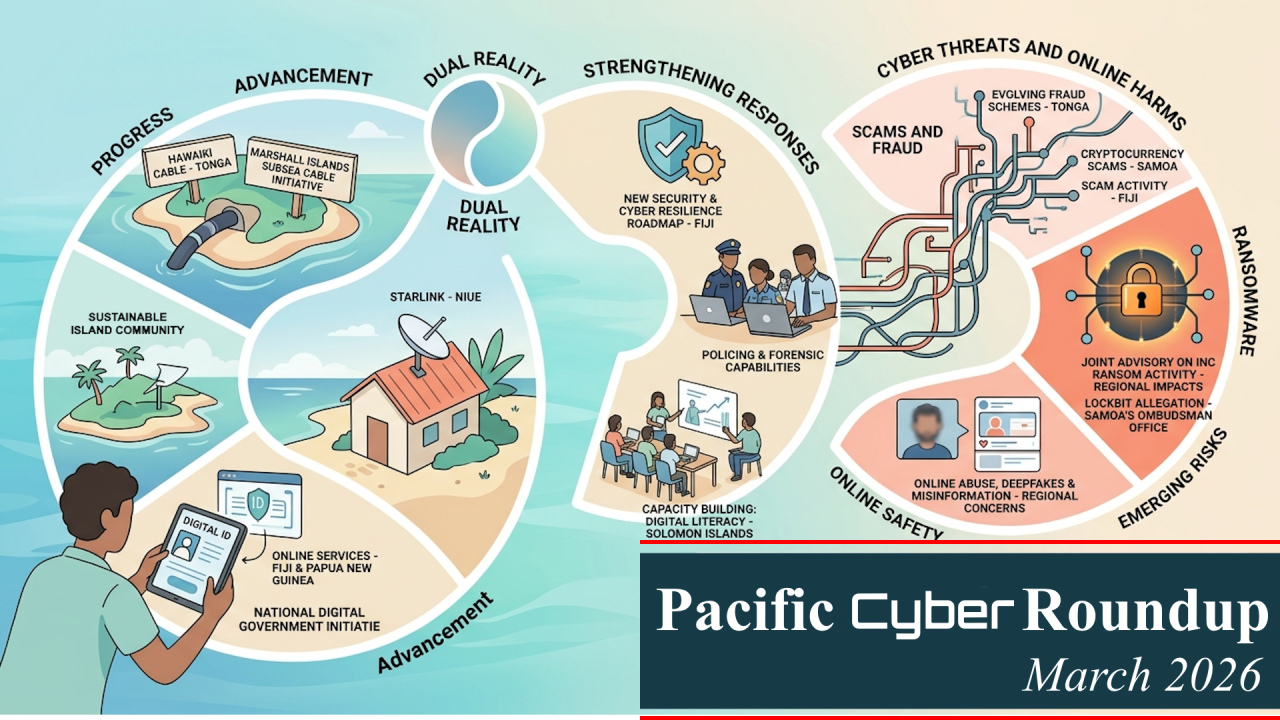
The March Roundup reflects a region progressing its digital and connectivity advancement agenda. This includes major infrastructure developments such as the Marshall Islands’ participation in new subsea cable initiatives, the landing of the Hawaiki cable in Tonga, and Niue’s granting Starlink temporary license to operate in the country. At the national level, countries such as Fiji and Papua New Guinea are progressing digital government initiatives, including digital ID systems and online public services.
At the same time, harmful activity in the cyber domain persists and continues to grow in sophistication. Reporting this month highlights the persistence of scams targeting Pacific communities, including evolving fraud schemes in Tonga, cryptocurrency-related scams in Samoa, and ongoing scam activity in Fiji. Ransomware also remains a concern, with joint advisories and reporting on INC Ransom activity affecting the wider region, including links to incidents in Tonga. Samoa’s Office of the Ombudsman is also alleged to have been breached by the Lockbit group.
Online safety continues to be a prominent issue across the region. Several reports highlight the real-world impacts of online abuse and harmful digital behaviour, including cases in Fiji, as well as broader concerns around misinformation. Emerging risks such as deepfakes and technology-enabled exploitation are also gaining attention, alongside the broader societal impacts of online harm.
Encouragingly, governments and partners are continuing to strengthen institutional responses. Fiji, for example, advanced national planning through a new security and cyber resilience roadmap, alongside investments in policing, forensic capabilities, and cyber strategies. Capacity building efforts also continue across the region, including digital literacy initiatives such as media training in Solomon Islands.
As with previous month, the Pacific’s cyber landscape reflects a dual reality: steady progress in digital capability and governance, alongside increasing exposure to cyber threats and online harms that continue to test national systems and community resilience.
This trend is consistent with the Pacific Security Outlook Report 2026, which warns that the frequency and sophistication of cyberattacks are currently outpacing defensive capabilities. The report emphasizes that as the region becomes more reliant on critical infrastructure like undersea cables and emerging technologies like AI, it becomes a more attractive target for cyber and cyber enabled crime and foreign interference. To navigate this period of vulnerability, the Pacific must lean into collective action, prioritizing improved information sharing and a coordinated regional approach to safeguard its digital future.
Find out more on this and other stories below:
Policy and Governance
The Pacific Security Outlook Report (Pacific Island Forum Secretariat)
Govt launches strategic roadmap to strengthen national security and cyber resilience — (Fiji Village, FBC News)
Pacific broadcasters rethink news delivery in digital age — (RNZ)
Social media has changed disaster visibility in Fiji — (RNZ)
Diaspora notes a dark gap in digital economy — (The National)
Asia-Pacific faces a new era of risk — (The Fiji Times)
Cybersecurity and Cyber Threats
Cyber advisory on INC Ransom operations — (Australian Cyber Security Centre, Dark Reading, Insurance Business Magazine, Cyble, Kaniva Tonga)
Samoa Ombudsman Data Breach — (BreachSense)
Fiji and Australia deepen cooperation on Digital Transformation and Cybersecurity — (The Fiji Times)
Infrastructure and Capacity Building
Marshall Islands to connect to Google’s subsea cable — (Data Center Dynamics, SubTel Forum, Submarine Networks)
Niue greenlights Starlink as temporary provider — (RNZ)
Hawaiki subsea cable lands in Tonga — (Data Center Dynamics)
Digital ID to transform Fiji — (FBC News)
PNG advances digital ID rollout and AI adoption — (Biometric Update)
Cook Islands modernises civil registration — (PMN)
BBC Media Action concludes digital literacy workshop — (UK Government)
Australia strengthens Fiji Police forensic capabilities — (The Australia Today)
New forensic labs to tackle document fraud — (FBC News)
Police target cyber and crime threats — (FBC News)
Online Safety
When online abuse silences PNG’s young women — (UNDP)
Dark side of the scroll — (The Fiji Times)
Minister recounts uncontrollable crying after online abuse — (The Fiji Times)
Time to get serious about online safety — (The Fiji Times)
Fiji tackles justice gaps and online abuse — (FBC News)
‘A single lie can divide a nation’ — Tabuya warns on misinformation online — (Fiji Sun, FBC News)
Public urged to use social media responsibly — (FBC News)
Fake accounts fuel online harm — (FBC News)
Stigma fuels online crime impunity — (FBC News)
Deepfakes and voice clones threaten children’s safety — (FBC News)
Online child sexual exploitation in the Pacific — (Global Initiative Against Transnational Organized Crime)
Former teacher awaits sentence appeal ruling — (Fiji Sun)
CBS warns public of dodgy investment scheme — (Samoa Observer, Samoa Global News)
SFC Vibe scam persists in Fiji — (Pacific Scoop)
Navosa gets power after decades — (FBC News)
Ana Masere warned to follow court order on TikTok use — (Fiji Sun)
Online scams affecting Tongans take a new turn — (Kaniva Tonga)
Thorough checks key in abuse investigations — (FBC News)
Digital Transformation and Services
Vola ni Kawa Bula records go digital — (FBC News)
New taxi permit application system rollout — (The Fiji Times)
Passport system upgrade underway — (The Fiji Times, Travel and Tour World, Fiji Sun)
This blog first appeared on Pacific Cyber Round Up at https://www.linkedin.com/pulse/pacific-cyber-roundup-march-2026-siosaia-vaipuna-qoevc/