Pacific Cyber Round Up - April 2026
Written by Siosaia Vaipuna
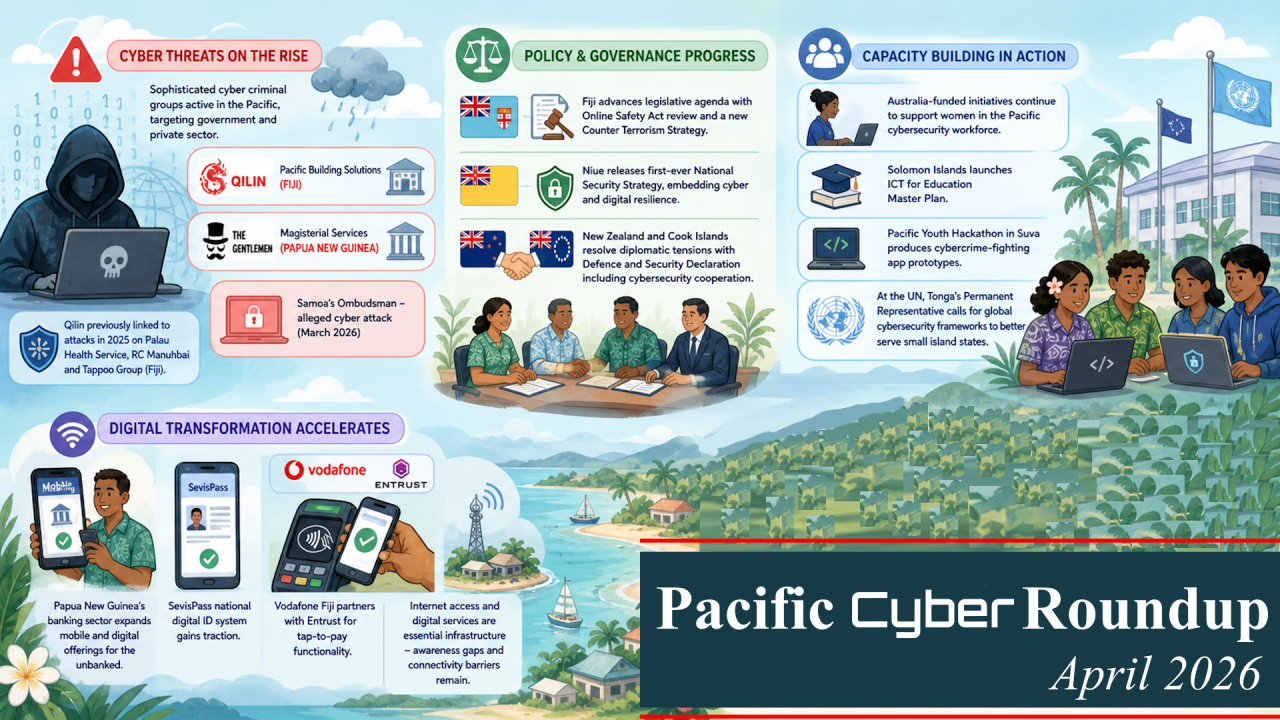
April 2026 was a busy month for cyber and digital developments across the Pacific Islands, marked by a convergence of heightened cyber threats, active policy reform, and accelerating digital transformation.
Cyber incidents and ransomware saw an uptick with activity from well-known global cybercriminal groups reinforcing concerns that both government and private sector systems in the region remain exposed despite ongoing efforts to strengthen defences. Notably, the Qilin ransomware group listed Fiji business Pacific Building Solutions, while The Gentlemen group targeted Papua New Guinea’s Magisterial Services, publishing both entities on their respective dark web leak sites. At the time of writing, there have been no formal statements from the affected organisations nor coverage in Pacific media, underscoring ongoing challenges in cyber incident disclosure and awareness. These incidents also highlight persistence in threat actor activity, with Qilin previously linked to attacks on Palau's Health Service and Fiji businesses RC Manuhbai and Tappoo Group of Companies in 2025.
On the governance and policy front, countries across the region continued to advance cyber and digital related policy frameworks. Fiji progressed its Online Safety Act review, while Niue released its first National Security Strategy, embedding cyber resilience alongside broader national priorities such as climate security. Regional geopolitics also intersected with cyber, as New Zealand and the Cook Islands formalised a Defence and Security Declaration that includes cybersecurity cooperation. Meanwhile, Solomon Islands launched its ICT for Education Master Plan, and at the multilateral level, Tonga called for more inclusive global cybersecurity frameworks, warning that Pacific states risk being left behind. The Pacific Regional Infrastructure Facility (PRIF) published the Regional Interventions to Strengthen Digital Readiness and Resilience in Pacific Island Countries report which identifies common Information and Communication Technology infrastructure challenges across the Pacific with recommendations on high-priority regional interventions that could strengthen digital readiness and resilience.
Capacity-building efforts remained active, with initiatives aimed at strengthening both institutional and community resilience. These included an Australian-supported workshop for Pacific women parliamentarians on leadership, media, and online safety; a UNODC-led programme in Palau addressing transnational organised crime; and a DFAT-supported grant awarded to build cyber capacity among women in the Pacific.
Online safety also received increased attention, with community-focused initiatives such as Samoa’s cyber safety awareness programmes and Netsafe New Zealand’s partnership in Fiji to deliver digital literacy training for senior citizens, reflecting a growing emphasis on protecting vulnerable groups in the digital environment.
At the same time, digital transformation continued to accelerate across the region. Papua New Guinea expanded digital banking services and advanced its national digital ID system (SevisPass), while fintech innovation progressed through partnerships such as Vodafone Fiji’s tap-to-pay rollout. In Samoa, new agreements are also enabling local businesses to expand into online payments, supporting broader digital economic participation.
Overall, April reinforces a clear trajectory: as digital adoption accelerates across the Pacific, strengthening cybersecurity resilience, improving incident transparency, and scaling institutional capacity will be critical to managing an increasingly active and complex threat landscape.
Find out more on this and other stories below.
Policy and Governance
Regional Interventions to Strengthen Digital Readiness and Resilience in Pacific Island Countries (PRIF)
Online Safety Acts review underway (FBC News)
Papua New Guinea digital poverty (Borgen Project)
Protecting a way of life: Niue’s first national security strategy (Toda Peace Institute)
Tonga pushes for action on cybersecurity (Island Times)
Solomon Islands ICT for Education Master Plan 2026–2030 (Government of Solomon Islands)
WHO Tonga multi-hazard communication strategy (WHO)
Starlink ruling in PNG (The National)
Journalist plans legal action against Meta and Google (Samoa Observer)
Joint communiqué: Pacific security meeting (Australian Department of Defence)
China out, NZ back in deal with Cook Islands (1News)
India strengthens ties with Vanuatu and Tuvalu (Tribune India)
Pacific faces growing polycrisis (PMN)
New counter-terrorism strategy aims to keep Fiji ahead of threats (FBC News)
Cybersecurity and Cyber Threats
Magisterial Service data breach (Breachsense)
Qilin ransomware strikes Pacific Building Solutions (DEXpose)
Cybersecurity gaps threaten online safety (FBC News)
Online Safety
Police warn of internet dangers (Samoa Observer)
Online Safety Awareness For The Elderly Community (Pressreader)
Concern over AI-generated pictures (Samoa Observer)
Police cybercrime unit investigates online post (Fiji Village)
Infrastructure and Capacity Building
Workshop helps untie knots of power, protection and representation (Parliament of Victoria)
Youth build apps to fight cybercrime (FBC News)
UNODC: Transnational organised crime in Palau (UNODC)
Vodafone PNG expansion continues (Business Advantage PNG)
Cambridge Global Advisors awarded grant to Build Cyber Capacity Among Women in the Pacific from Australia's DFAT (Yahoo Finance)
Digital Transformation and Services
PNG banking enters its digital age (Business Advantage PNG)
Vodafone Fiji and Entrust tap-to-pay partnership (Fintech Futures)
New deal paves way for e-Commerce growth (Samoa Observer)
Fast, reliable internet now a household essential (Fiji Sun)
Fiji digitizes disaster tracking (FBC News)
PNG digital ID (SevisPass & SevisWallet) (GovInsider)
FAO PNG brings work online (FAO)
This blog first appeared on Pacific Cyber Round Up at https://www.linkedin.com/pulse/pacific-cyber-roundup-april-2026-siosaia-vaipuna-kadac/